

Did you know that the color you perceive from any object, is the opposite to its real color? This fact has deep mind-expanding and unexpected implications. Let’s dive in …
The perception of colors is a complex light-matter interaction that involves mainly three elements: the illuminated object (transmitter), the eye + brain (receiver) and messenger (electromagnetic radiation, i.e., light that bounces off the transmitter and arrives to the receiver). Light-matter interaction is an exquisite and very sophisticated communication process between an outside world and an inner experience, through a physical process known as resonance. Color is resonance happening between matter, or confined vibration (frequencies that carry a certain energy, and that are confined in a region of space) and light (free propagating vibration, i.e., frequencies that also carry or transfer energy). Light-matter interaction is a energy transfer (information transfer) process. In that sense, we can say that reflected light propagates information of matter, and that matter is confined light.
Color is a signature of light-matter interaction that depends on the atomic constitution of matter and its normal modes of vibration – the confined frequencies -, but this feature only reveals itself when light impacts it. The perceived color coming from the object depends on the intensity and energy – frequency, i.e., color- of the incident light, while the message (the reflected or emitted light) is interpreted in one way or another depending on the receiver. A note of caution here, colors are associated to frequencies of light, while perception of color is a different thing. We don’t know if we all see the same red, but we do know that what we mean by red will always be associated to a frequency range of 400 to 480 terahertz (THz), corresponding to a wavelength of approximately 620 to 750 nanometers (nm). Color has an objective aspect, quantifiable as frequency. But the perception of it, is subjective as the biology can change in individuals, for instance in a color blind person. We think we all see the same. One would need a third reference, a witness (internal or external) that could see the tone of red you are seeing and the one that I am seeing, and compare them, to tell up to what point we are perceiving the same tone or color. This is where things get tricky, were is that witness located? Up to what resolution can the differentiation be made?
When the light spectrum illuminates an object, the object absorbs certain frequencies from the incident light and their color complement in the incident light spectrum is left ‘unpaired’, alone, traveling back to the receiver as reflected light. This color complement predominates when reaching the eye and perceived by the brain. We see the complementary opposite of what the object’s color is (the frequencies it absorbed). Light bouncing back to the receiver is ‘incomplete’, it lacks some of the frequencies or energies it carried before impacting the object. It is as if the message was given in terms of what the light beam lacks. The case of fluorescence, that is, materials that emit the absorbed light, is more complex and will not be considered here. For a more detailed explanation go to Seeing Color.
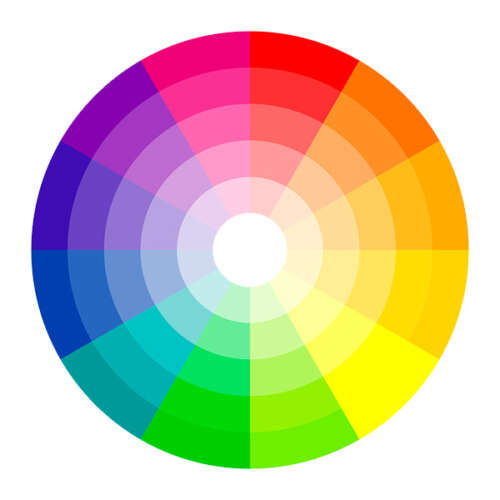
The chromatic circle known as color wheel, visually depicts colors and their combinations, serving as a fundamental tool in color theory. An interesting thing about it, is that if I make it spin, at a certain rotational frequency, colors are no longer distinguished separately, it looks white to the brain. Wavelengths from the light spectrum arrive on the chromatic circle and each color in the circle absorbs its complementary color from light, reflecting the others. As this happens with all colors equally -all are absorbed and reflected- the reflecting parts reconstitute the original stream of light, and we see it white. Our brain perceives something we call white, which is the sum of the colors reflected by this object that reached the eye. Watch the video below for a more detailed explanation.
An object is seen as magenta because its atomic composition have absorbed on average:
- The complementary -green- and the reflected light that bounces off the object does not have green among its components or frequencies. Magenta, which is in opposition to green in the chromatic circle, is de compensated and magenta takes over.
- All the colors are absorbed except magenta, and only magenta reaches the eye.
- All the colors, minus those who combined in the brain will be seen as magenta.
In all cases the object is (absorbs) all colors or frequencies except the ones that reach the eyes. We perceive light that bounces off objects and that contains the complementary frequencies of the colors absorbed by objects. The light I receive from this object lacks green (case 1, shown in the image below), or all colors except magenta or a combination that recomposes magenta (case 2 and 3), and that is why I see magenta coming form it.
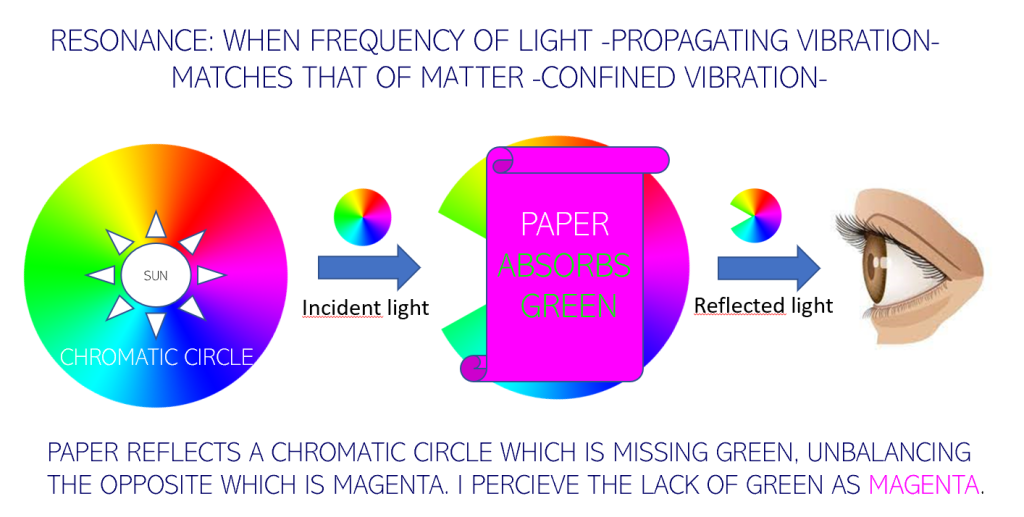
In summary, color is the light that bouncing from objects reaches the eye. That object is ‘being’ magenta from outside, but ‘IS’ green (absorbs green) or is everything but magenta from the inside. It looks magenta, which is what corresponds to the action of seeing it from outside. And it is seen or being perceived to the outside (magenta), as the opposite of what it is, in it self (green). It is a sort of entanglement, where the correlation between magenta and green is that they are in complementary opposition. The object is magenta, means that the object is or absorbs all but magenta. It is like taking its inverse, the negative of it. This is information theory, expressed in terms of light-matter interaction.
What about extreme cases black and white?
In a white object, the white color does not exist as such, in the sense that I can’t associate it with a set of frequencies. The Sun light (spectrum of ‘all’ wavelengths, including the visible) impacts on a paper constituted of atoms that don’t absorb any of the visible wavelengths, they reflect all and reach the eye. Our convention establishes the presence of all these waves reaching the eye as ‘white’. Meanwhile, a black object is made up of atoms that on average absorb all visible wavelengths; the convention establishes the lack of wavelengths reaching the eye as ‘black’. To be consistent, one should establish a reference; I will call white that which absorbs nothing from the visible spectrum, and black what absorbs all. Black is the absence in the retina (or presence on the object) of all colors been absorbed by this object, while white is their presence in the retina (or absence on the object) of all colors.
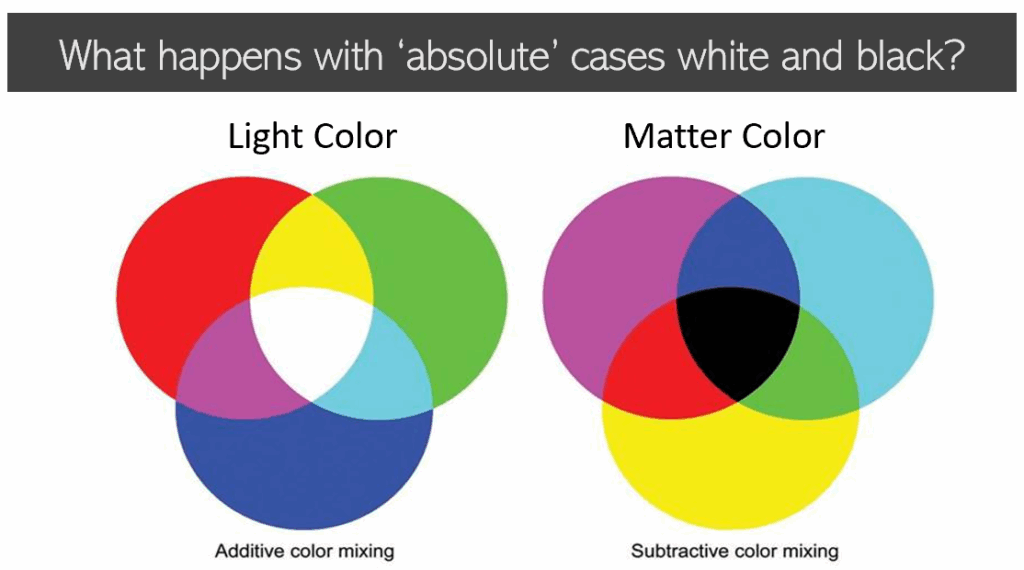
The oil looks black from without, but it is potentially white from within, as it contains all colors of light inside. We could establish an additional reference frame by saying that oil is potentially white from the inside (if the observer is inside the object). Paper looks white from without, though it is potentially black from within, as it lacks all colors of light. It is potentially black from the inside of the paper (if the observer is inside the paper). Potentially black and black differ in their dynamics; the first is going from the inside out (from the object to the observer), while the dynamics of the second is going from the outside in (from the observer to the object). It seems to me that the reference can be set arbitrarily for the first case, and the other cases must be assigned in accordance with the first. The critical factor is the consistency in the reference system, showing the existence of a gradient, a flow, a sense.
How is it with light?
From the rationale we are applying here, it’s not possible to associate light with black or white exclusively. Let’s see why … If white light contains all wavelengths, as if it had absorbed them a priori, I could say that it is fundamentally black from without. If there is an observer capable of seeing light directly and not its effect on objects, the light would then no longer be black, to be potentially black or potentially white according to the new observer.
Considering all these elements, the question, ‘is light white or black? ‘ has a four sided (tetrahedral) answer :
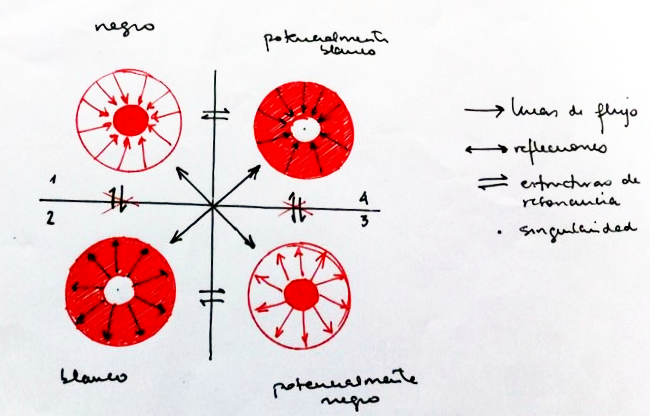
This result can be reformulated as follows: in order to have a self referring or self-contained frame of observation, one needs at least these four particular reference frames. This seems to be the irreducible representation of information exchange.
Light-matter interaction has deep philosophical implications. The ‘being’ to the outside is characterized by that which depends on the detection system, interaction or measurement, while the being to itself, or simply put ‘self’ is independent of this. The opposites ‘being’ and ‘self’ can only be the same thing if the transmitter and receiver are the same, what is to say that there is no transmission of message. It is the messenger and message at the same time. Light without interacting with any object would fulfill this role, and therefore a observer traveling at the speed of light would also. Though, a famous physicist’s theory explains that no object can travel faster than or at the speed of light in vacuum. Therefore, any-thing traveling at lower speeds cannot be ‘being’, and ‘self’, at the same time. And the origin of the light, that’s another story.
As the observations or measurements of ‘being’ involve the interaction with something that a priori «can only be for itself» (as with light, whose reference is itself), in the search of ‘that what is’ (as with the matter, whose reference is light), we only determine what the object is for who is measuring or observing it, losing the essence of ‘itself’ as long as the description of its «what is it?» (or its ‘being’) increases, since they oppose, no matter the number of states included to define it. This fact is equivalent to Heisenberg’s uncertainty principle in the atomic world: the more accurate is the measurement of the position of a particle, less is the accuracy of the speed of the particle. In simple terms, the more you know about the direction of the particle, the less you know where it is at, and the more you know the position of the particle, the less you know where it is heading to. It also means that the whole is NOT equal to the sum of its parts …
A second deep implication that passes unadvertised, is that if light-matter interaction is a quantum mechanical effect (since matter happens at certain frequencies and the energy exchange between light and matter happens in integer amounts of energy called photons) given that we have addressed this interaction in terms of reference frames, we have linked a critical aspect of quantum mechanics and relativity in a very subtle way: an observation with respect to reference frames (relativity) that when combined becomes self-referring (confined or quantized into a quantum of consciousness), building the notion of ‘an observer’.
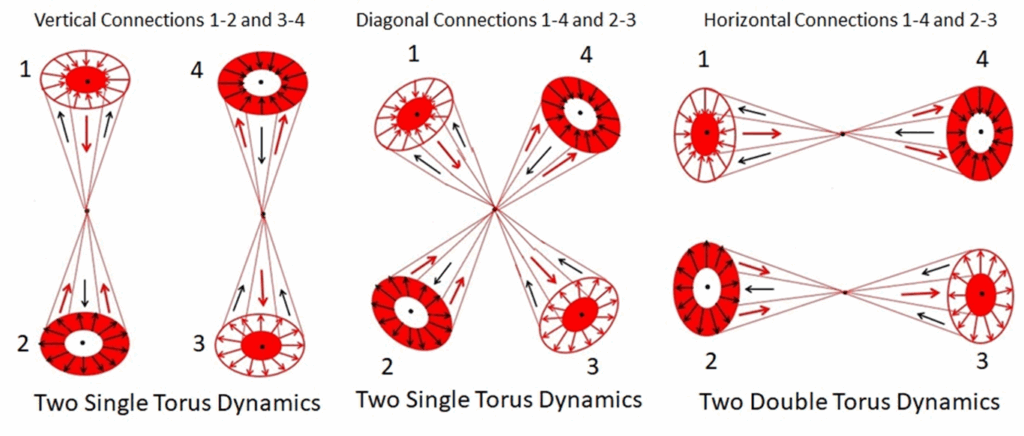
An observer is a self-referring frame of observation, therefore, it is absolute or universal only with respect to itself. It’s interesting that the flow of information depicts a continuous picture (relativity) which generates a granular picture (quantum mechanics), and vice versa, as if one was embedded in the other, depending on the scale you are looking at. This could also be connected to the wave-particle duality, in a much broader sense than what quantum mechanics tells us. It is not that the particle behaves as a wave or as a particle depending on how you observe it. The particle is made up of waves (oscillations, fluctuations, rotations in a seemingly continuous flow) that are confined (i.e., quantized) in a region of space and those waves are made up of smaller particles (i.e., smaller quanta or confinements of inner flows), such that one will detect a granular or fluid aspect depending on the scale we look at. It is a fractal ‘Russian doll’ type of relationship.
Learn more about this mind expanding framework, in our course The Science of Serendipity and the Quantum of Consciousness (insert link).