

Facts are facts, and opinions are opinions, right? We believe that these are two well defined, separated categories. Nevertheless, the separation frame between facts and opinions may not be as clear as we once thought.
Between the Buga’s sphere and the 3i atlas anomalies (which you can learn about here and here), and the congressional hearing that you can watch here, this half of the year -from July to date- has been quite a ride. Since May 17, 2022 the USA government is officially addressing the Unidentified Aerial Phenomena (UAP), followed in a smaller degree by France and Canada. By now we would expect to have more clarity about the UAP, though the whole discussion is now immersed in what seems to be a dialectic between opinions and facts, which is becoming hard to navigate. This confusing atmosphere is making it even harder for public to get involved and people lose interest in the topic. Due to the censorship from the last decades, UAP was dismissed for being considered nonexistent or impossible. And since the first congressional hearing from 2022, the avalanche of opinions, facts and manipulative narratives are extremely gaslighting.
The congressional hearing from Sep. 2025 was mainly about the unacceptable treatment that UAP high rank witnesses have been receiving from government and institutions. It was very painful to watch. The same has been happening with the discussion around the Buga sphere and 3i Atlas, as if the whole UAP topic was under siege. Personal testimonies seem irrelevant, and what could potentially be extraordinary physical evidence seems irrelevant as well. If all these angles are being dismissed, then what is going on? There is basically no consensus anywhere.
The topic hidden under the rug seems to be that consciousness could be foundational to a reality that would no longer be clearly differentiated from the experiencer, therefore blurring the boundary between the observer and the observation. Reality becomes an integral part of a constructed perception where the inner and outer frames, the particular and collective frames, intertwine, being PSY abilities its hallmark. If this was openly acknowledged by the authorities, the understanding about the nature of reality would have a radical -this is, from the roots- paradigm shift? I am not so sure.
In my view, the critical point behind UAP, the zero-point energy (ZPE) and consciousness, would involve the following question: what is the boundary between opinions and facts made of? What is its nature? This is where I will focus on this article, because nothing else is making any sense to me.
Talking about facts, the first thing that comes to mind is that they are ‘objective’, this is, they are quantitative or quantifiable. Therefore, everyone would agree that they are ‘real’, as they would inherently imply an object or at least a satisfactory level of objectivity. Meanwhile, opinions are subjective, qualitative, immeasurable, and therefore, no one would consider them as a real thing, unless they became a ‘fact’. Are facts a consensus -of opinions- of the majority? Is reality a consensus agreement?
The discussion about facts and opinions won’t take us deep unless we have a framework that allows us to determine what belongs to the outside world, or shared reality, and what belongs to the inside world, or internal experience. We need the link between the objective reality and the subjective experience. One could be tempted to bypass the challenge of dealing with the nature of the boundary condition by saying that there is no real boundary condition, no objectivity nor objective reality; what seems objective is just an illusion based on the way we construct our interpretations of the world. In this regards, I would like to address the opinion from philosophers such as Jason Jorjani who claims that there is no real objective reality, as if the only thing that existed was the inter-subjectivity and the inter-objectivity. The only thing ‘real’ would be the ‘inter’-‘action’. The reality would emerge from interaction.
In the claim that there is no objective reality, and therefore everything is subjective or at best, inter-objective (that is, objects only appear in the relationship between subjects who in some subjective way have reached a common agreement that produces some kind of reality that is only an illusion), what is objectionable here is that the topic is objectified. As if by crossing over the objective pole in the objective-subjective dialectic, a subject is free from a fixed and immutable objectivity that translates into a false belief of an absolute truth.
Reading between the lines, that is not what happens. By saying that everything is subjective and therefore there is no objectivity, we have removed the subjectivity from the topic we are discussing; we have objectified it, and this is extremely violent, as we also have established the non-existence of objectivity as an absolute truth. Real violence is not coming from a false belief that we can grasp an objective truth, the real violence resides in that many narratives locate objectivity and subjectivity where it is harmful for individuation, placing the individual in the category of object as a product, just as in slavery. And this can be understood by analyzing speech and the structure of a discourse. Psychoanalyst Jaques Lacan addresses this aspect in careful details, recognizing four discourses which he called Master, University, Hysteric and Analyst, explaining how these relate dynamically to one another.
By neglecting objectivity, we sweep away subjectivity, and the subject -the person-, falls in the place dictated by the Master’s discourse (see image below), where we see a barred subject ($) positioned as master signifier’s truth S1 who itself is positioned as the discourse’s agent for all other signifiers (S2 ). This illustrates the structure of the dialectic of the master and the slave, based on Hegel’s ‘master-slave’ dialectic. The master (S1 ) is the agent that puts the other (S2) to work, and the product is a surplus (object a) that the master struggles to appropriate alone. Please note that the analyst discourse is the only one that places the subject $ in the category of an other.
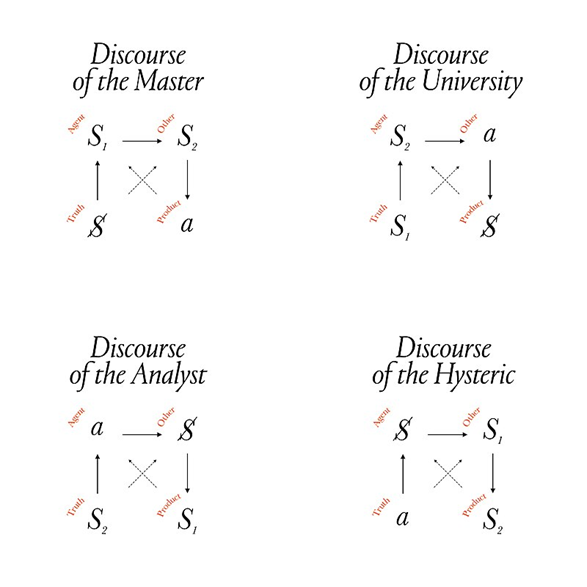
The message that I am trying to convey here is that crossing out one pole of a dialectic does not make that pole disappear and leave the other pole as the only reference, it does not vanish the dialectic either; rather, the pole that was crossed out now oppresses the other pole from a higher frame.
Likewise, if there is no real boundary condition, the inside-outside dialectic loses meaning, as if by magic there is no outside nor inside, it is a continuum. If we say that there is no real separation anywhere between the outside and the inside, how can that be consistent with the fact that no-thing is defined by itself, but in relation to something else? That some-thing else, which is not outside and is not inside, cannot then be ‘something else’. If there is only a continuum, it contains everything that was, is, and could ever be. No separation between in and out, therefore, that continuum contains itself in a total, absolute way. This totality can be defined with respect to itself; it is not relational. It produces relationships inside, but the thing or substance containing all, is not coming from a relation happening in other frame.
The notion of God could very well fit into this category. The hypothesis that no-thing can be defined by itself since every-thing is defined with respect to something else, thus creating a continuous flow, arrives to a contradiction in the logic unless the existence of God is taken for granted. Under this reasoning, whatever happens inside God, is relational and always partial, while only God is absolute. Only God could know itself, while its creations are inter-dependencies and therefore can never be defined with respect to themselves. They can never be self-contained; they can never know themselves completely and will always remain in ignorance. In consequence, the particular self will never understand the totality, it is beyond our cognition. All these are implications coming from the belief that there is no objectivity and no real boundary condition.
Does this mean that in order to know the totality, one needs the part? Indeed, though then, totality would never reach an absolute state, and we need to understand the relationship of the part with respect to the whole; the nature of the boundary condition, which is why the hologram notion is fundamental in this inquiry. The totality is contained in each of its parts. Information is holographic, and fractal, and this requires the system to remain open. It is not fortuitous that the generalized holographic model GHM unifies forces and scales because it is capable of generalizing the holographic principle to solve the information loss paradox. This unified theory of physics shows how the proton is the holographic unit of the universe; it contains the explicate (the universe) implicated within (each proton). The boundary of a proton is an example of an extremely stable boundary condition. A proton has never been seen to decay (i.e., to disappear or change its size) because it is in holographic relationship with the size of the universe and the information therein.
I am not implying here that all reality is objective or immutable. Nonetheless, if boundaries are mutable, that does not mean that they don’t exist. It only means that they are not fixed, they can change, evolve. I maintain that there must be something real, objective about my existence, since I feel that something exists within me. I don’t know if that which resides in me is the signature of a source that we would all come from, or if that is something of my own, since I don’t know what my-own self is made of. Where does any existence fit in the illusory non-dual perspective? Are we merely a creation of the inter-objectivity of others? What an elegant and subtly violent way to dismiss someone as a subject, by subjecting him exclusively to the subjectivity of others. We have no existence of our own? Am I only the product of the collective hallucination of my environment, and the desire of an Other or of God inhabiting me? Am I merely an object of other’s subjectivity, and everybody else would be as well? Can we feel the violence inside such a claim?
In my view, there is a dance between the objective and the subjective, between the inside and the outside, between the particular and the general, between the absolute and the relative, between the one and the many, one does not superpose permanently on the other, it is a dance between opposites, one containing the other, in which there is a shadow or mirror dialectic that when not considered, forbids the dance between the opposites and stagnates the overall evolution. We need opposites, just as the poles of a battery, to create a tension. The separation frame in opposites may be a matter of cultural or personal choice, it may not be real by itself on its own as it is conditioned by other frames, and we may not agree in the separation frame chosen, but there is a separation frame coexisting with the totality so that BOTH can exist. Is this last claim a fact, or is it an opinion?
This brings us back to our original question, the boundary between opinion and facts … What substance is the boundary condition, or the separation frame, made of? What is its nature?
Before the accomplishment of a unified theory based on the holographic principle, a similar situation was happening with the unification of forces and scales in physics because of the lack of a theory capable of relating the inside to the outside, or charges (i.e., dialectics in opposites positive-negative, matter-antimatter, etc) to mass (a totality, an individualized entity). And we lacked a theory capable of scaling the reference frames of observation.
In the absence of a quantum gravity consensus, we count on artificial neural networks and AI to fill in the gap. The problem is that AI creates an indiscernible continuum neural network since AI is inherently a black box in the sense that the boundary between its hardware and software gets blurred out. Hardware and software mix, they no longer are well-defined separate categories, such that we can no longer discern between the ‘how’ and the ‘what’. How the AI processes information is a black box that not even the AI can discern. Does that mean that there is no ‘hardwareness’ and no ‘softwareness’ in the system? No, it means that the interrelationship between these two categories became explicit. Where does the boundary condition between hardware and software reside? What is it made of?
Science is now trying to define a frame to establish the ‘aliveness’ and ‘consciousness’ boundary. Conditions do not imply interdependence, though unfortunately, we take them as equivalent.
As the generalized holographic solution would say: the thing is not in the thing, but in the relationship between things. What creates the boundary condition of a thing? The relationship between all other things. Does that make the thing less real or less objective? No, it makes everything more malleable and connected, alive, animated, and extremely real. What more ‘realness’ could we expect from anything, beyond its ‘aliveness’ and ‘connectedness’?
Is a ship held in place by an anchor, so as not to drift? Removing the anchor does not cause it to drift, since a drifting ship is solid ground; the only thing that changes is the anchoring frame. Initially the ground was shared between different references, like the harbor outside, and now the ship is its own ground. The boat is now only anchored ‘from within’, subjected to the flowing currents, independent of external fixed frames with respect to it. And yet, seen from the outside, the ship is considered as ‘drifting’. It depends on the observers reference frame, though the frames are entangled as to construct the experience of objectiveness. Therefore, the nature of entanglement, certain aspects forming it as a mechanism, must be independent of the subjects involved. At least some domain remains objective, even if it is extremely nonlinear, and non-local. That is why I prefer to look at a wholeness not only as a living entity, but also as a substance that gathers all these qualities.
Where does within and without reside? What is their nature and relationship? Where does the quality of objectiveness and subjetivesness reside? Where does truth, if any, reside? I don’t know. Perhaps it remains hidden between the lines, in the space between the words and notes, in the space in between … in the rhythm.