
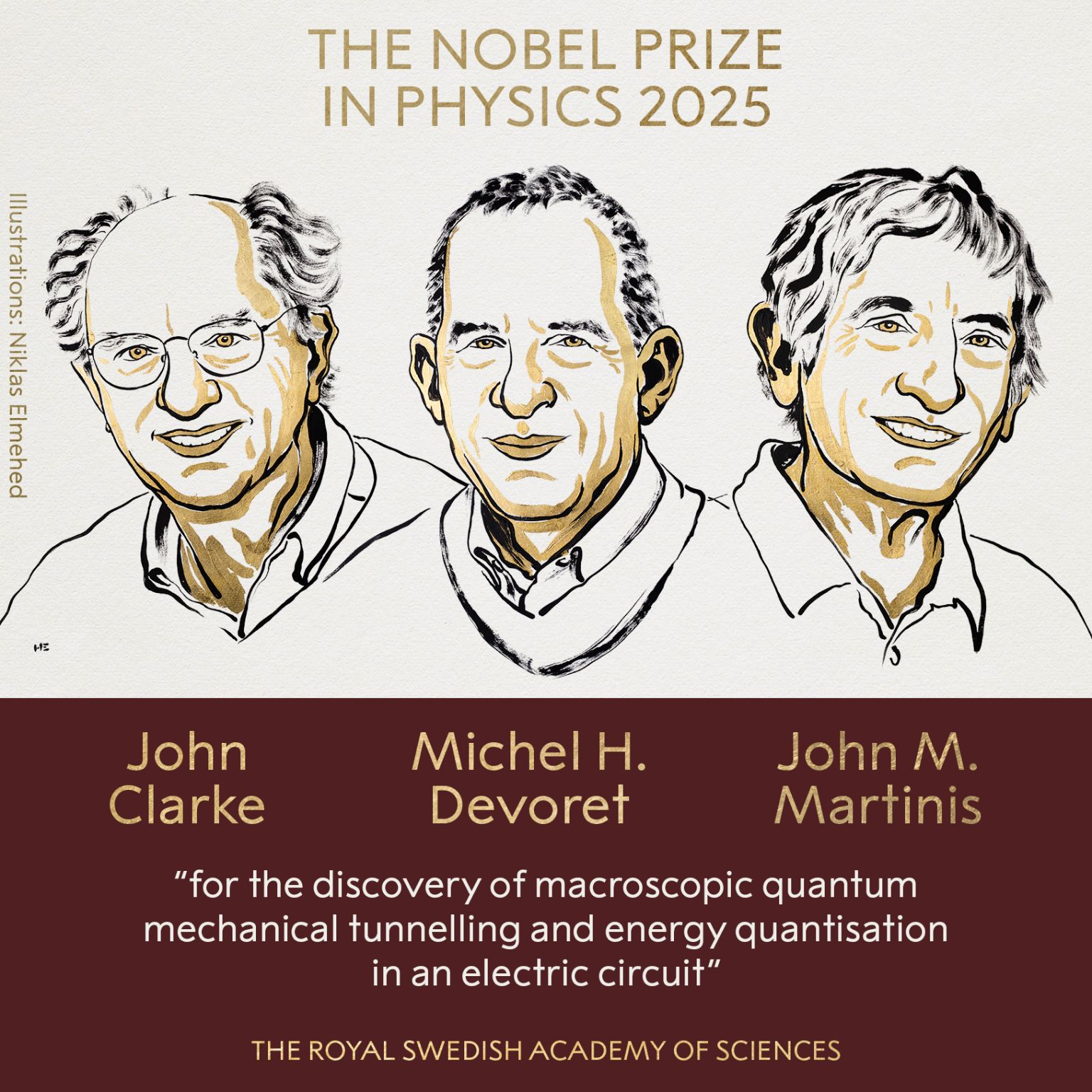
The recent Nobel Prize in physics was awarded to John Clarke (UC Berkeley, USA), Michel Devoret (Yale University, USA), and John Martinis (UC Santa Barbara, USA), for showing that quantum effects can exist on a human scale. Their work shows that quantum weirdness, in particular quantum tunneling, can be achieved in macroscopic devices, therefore proving that mysterious is not reserved to the tiny, microscopic scale. Quantum coherency has been proven to be preserved in exceeding large conglomerates of atoms, and this has deep implications for biology and even for consciousness.
In 1984 and 1985, the now laureates had built a tiny superconducting electrical circuit in a super-chilled environment, that allows the current to flow without resistance, through a process knows a Cooper pairs. The superconducting components of the circuit were separated by a thin layer of non-conductive material, a setup known as a Josephson junction. This circuit behaved just like a quantum particle; it could tunnel through barriers, and it could absorb and release energy not continuously but in tiny fixed discrete amounts, called quanta, just as quantum physics predicts.
The charged particles moving through the superconductor behaved as if they were a single particle that filled the entire circuit. This macroscopic particle-like system is initially in a state in which current flows without any voltage, trapped in this state as if it was behind a barrier that it cannot cross. Its quantum character reveals by managing to escape the zero-voltage state through quantum tunneling, detected by the appearance of a voltage. This discovery helps the development of quantum computers, which work using these strange quantum states to process information in ways that normal computers can’t.
Quantum behavior is preserved at macroscopic scale … what does this mean? In simple terms, if quantum behavior can be preserved at macroscopic scales, and even at room temperature (for example the entanglement in diamonds, the proton tunneling in DNA, or the BEC behavior in photosynthesis), it may be that the macroscopic world is not as classical (local and linear) as one would imagine. Most of the biological processes would therefore involve quantum processes that science is still unable to acknowledge. One could draw a link between the fact that the science we have developed so far describes at most 5% of the physical reality around us (the remainder falls into the category of the yet undetected dark mass and dark energy), and, the unacknowledged quantum processes that could very well be responsible for the missing 95% which we know almost nothing about, and that seems to be holding reality together. Since the equations of general relativity developed by Albert Einstein, which basically are the updated version of the Newtonian physics corresponding to the classical world, require the existence of dark mass and dark energy to explain the behavior of mass at cosmological scales, clearly something huge (larger that 95% if we realize that the mechanism giving rise to mass is accounted for in 96% by the strong force) is missing in our understanding of the nature of reality. But not only physical reality is immersed in this conundrum. The pervasive consciousness, currently so in-vogue in the scientific debate, is the real feast. What is consciousness? Where does it come from? Is it an emergent property of complexity in biology? Or is consciousness fundamental to the physical world, as many ancient cultures affirm? Or a combination of both? A sure bet in this discussion, is that whatever mechanism is behind the nature of reality, it is also behind consciousness, and in a 95% certitude, it involves the unacknowledged 95% of reality. The unknown, unseen, vacuum; the empty space, the space in between.
Let’s not forget that 99,999999999% volume in matter, is vacuum. Therefore, vacuum must surely play the predominant role in this inquiry about the nature of reality.