
About the Quantum of Consciousness
Have you ever wondered where the quality of anything resides? We are used to think that properties such as that of being hot or cold, big or small, far or close, are exclusively inherent to the entity (water, trees, planets), without realizing that these characteristics are relational, i.e, in relationship to a reference. The hotness of coffee, the sweetness of apples, all qualities imply a frame from which a comparison is anchored, such that when we say ‘hot’ or ‘cold’, it is with respect to something hotter or colder. Where is that frame from which the quality of something is anchored? That frame is what we could call an observer. What is it made of? Is it made of quanta or particles of consciousness?
Information is not a thing, it is a relation between two or more things, which on their own are also relational with respect to other things. In that sense, the thing is not in the thing, but in the relationship between things.
The Quantum of Consciousness tackles these fundamental questions:
- What does information mean?
- What is an observer? Where is it located?
- What do we mean by consciousness? Is the universe conscious?
- What relationships can be drawn between the observer and the reality it observes?
- How can the observer create and affect an information consciousness field?
Such integration unifies the dynamics of consciousness and the fabric of spacetime, where the observer/experiencer is spacetime observing and experiencing itself.
“The Q of C was born from my experience in light-matter interaction through quantum mechanics. The hypothesis behind the Q of C theory is that the observer is enfolded in the information that it displays, it is inherent to the information it carries. The theory describes an imbrication of reference frames to build ‘an observer’ (a self-referring frame or Q of C ) and by connecting these frames, an information loop appears with the shape of a double torus dynamics that I associated with the quantum vacuum fluctuations in 2004.
The double torus dynamic is a feedback-feedforward mechanism, a self-referring loop of information. This perspective tells us that each point in space could have the quality of self-reference, a proto-self-awareness. The quality of consciousness, therefore, would be imbued in the very fabric of spacetime, propagating to all scales, from the very small or internal -atoms and deeper- to the very big or external -stars, galaxies and the universe itself-.”
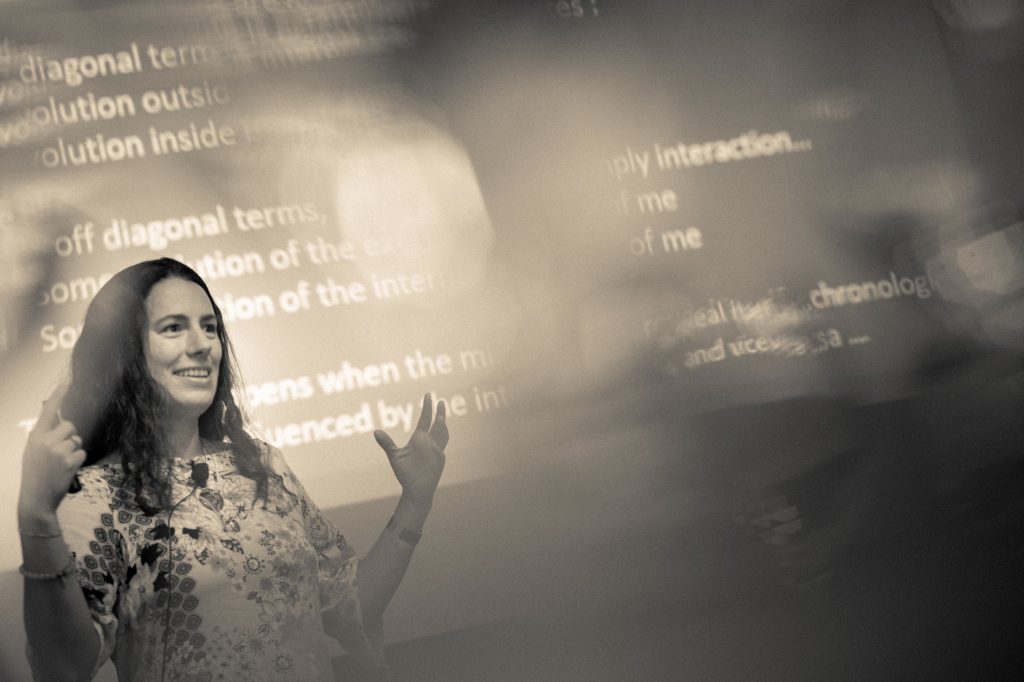
Dr. Urdaneta’s work on the Q of C, led her to define consciousness as: the concatenation of reference frames of observation (i.e, observers or quanta of consciousness) that reaching a fractal condition, coalesce into singularity, i.e., into a black hole.
Black holes are extreme gravitational entities. The coalescence of observers into a black hole could be thought of as a collapse of the wave-functions in quantum mechanics. And scientists now think that the collapse of the wave-function could be due to gravity. If so, then the collapse of the wave-function would be due to consciousness. Black holes also embed a fractal geometry, as fractals are the most optimized way for information to be packed in a region of space. Therefore, consciousness is a fractal and gravitational effect. Fractal and gravitational signatures of consciousness were found in Shintergy experiments, with very promising results.
The Q of C theory provides a grounded quantitative and qualitative framework to address the quantum vacuum fluctuations and black holes from the perspective of an ‘observer’. In other words, how the quantum vacuum fluctuations, and their collective organizations into white/black holes, emerge from the notion of the observer. Black holes would be conscious hubs on the universal network.
The thing is not in the thing, but in the relationship between things …
– Dr. Inés Urdaneta
The Q of C connects in an unexpected way with proposals from thinkers such as Charles S. Pierce, José Luis Parise, and Ken Wilber, to name a few. It coincides as well with worldviews from various ancient cultures, such as those provided by the I-Ching or sacred texts from Hebrew, Hindu and Muslim traditions.
An inherent political dimension of consciousness is another aspect embedded within the theory.
The Q of C framework, its applications and results are surprising.