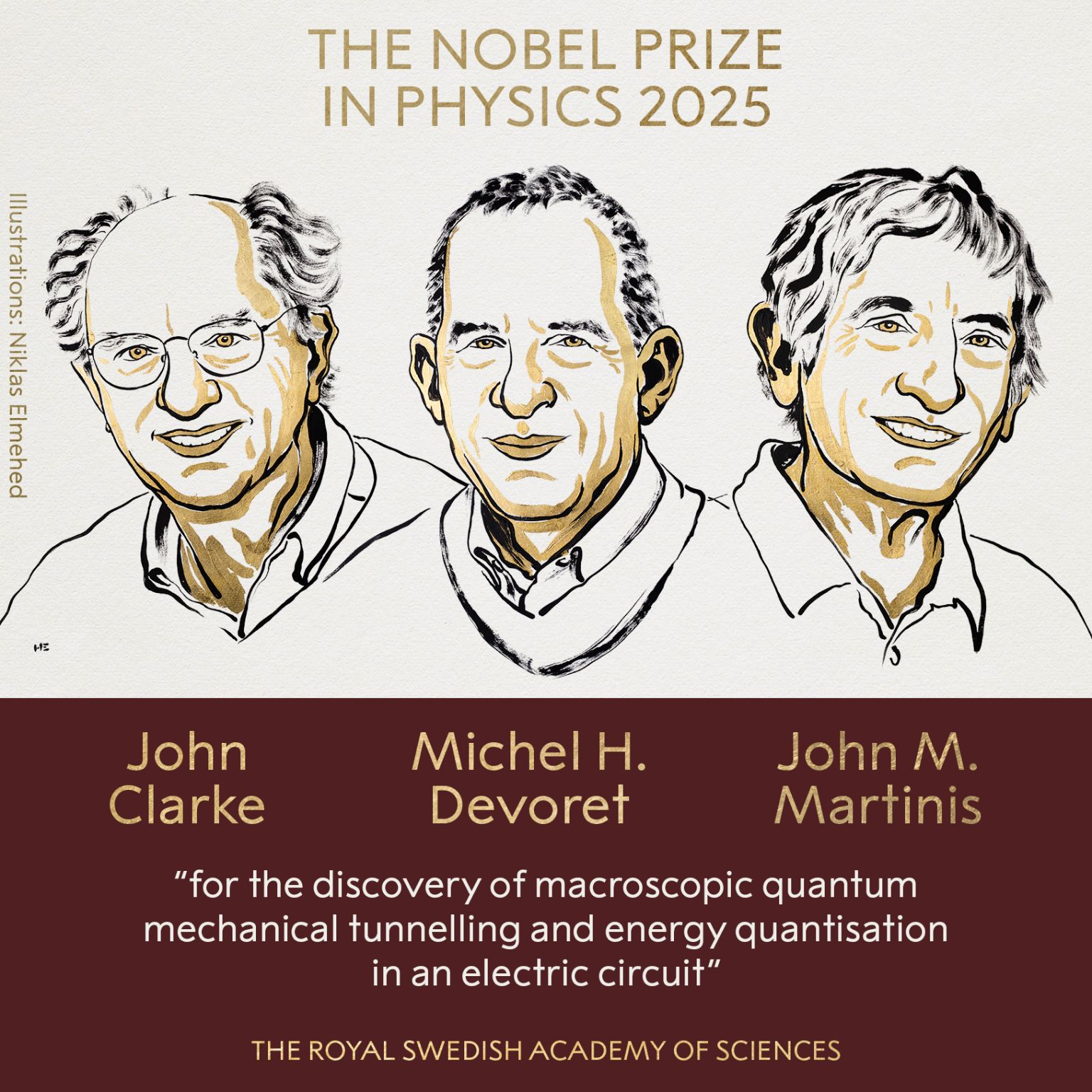
The recent Nobel Prize in physics was awarded to John Clarke (UC Berkeley, USA), Michel Devoret (Yale University, USA), and John Martinis (UC Santa Barbara, USA), for showing that quantum effects can exist on a human scale. Their work shows that quantum weirdness, in particular quantum tunneling, can be achieved in macroscopic devices, therefore proving that mysterious is not reserved to the tiny, microscopic scale. Quantum coherency has been proven to be preserved in exceeding large conglomerates of atoms, and this has deep implications for biology and even for consciousness.
In 1984 and 1985, the now laureates had built a tiny superconducting electrical circuit in a super-chilled environment, that allows the current to flow without resistance, through a process knows a Cooper pairs. The superconducting components of the circuit were separated by a thin layer of non-conductive material, a setup known as a Josephson junction. This circuit behaved just like a quantum particle; it could tunnel through barriers, and it could absorb and release energy not continuously but in tiny fixed discrete amounts, called quanta, just as quantum physics predicts.
The charged particles moving through the superconductor behaved as if they were a single particle that filled the entire circuit. This macroscopic particle-like system is initially in a state in which current flows without any voltage, trapped in this state as if it was behind a barrier that it cannot cross. Its quantum character reveals by managing to escape the zero-voltage state through quantum tunneling, detected by the appearance of a voltage. This discovery helps the development of quantum computers, which work using these strange quantum states to process information in ways that normal computers can’t.
Quantum behavior is preserved at macroscopic scale … what does this mean? In simple terms, if quantum behavior can be preserved at macroscopic scales, and even at room temperature (for example the entanglement in diamonds, the proton tunneling in DNA, or the BEC behavior in photosynthesis), it may be that the macroscopic world is not as classical (local and linear) as one would imagine. Most of the biological processes would therefore involve quantum processes that science is still unable to acknowledge. One could draw a link between the fact that the science we have developed so far describes at most 5% of the physical reality around us (the remainder falls into the category of the yet undetected dark mass and dark energy), and, the unacknowledged quantum processes that could very well be responsible for the missing 95% which we know almost nothing about, and that seems to be holding reality together. Since the equations of general relativity developed by Albert Einstein, which basically are the updated version of the Newtonian physics corresponding to the classical world, require the existence of dark mass and dark energy to explain the behavior of mass at cosmological scales, clearly something huge (larger that 95% if we realize that the mechanism giving rise to mass is accounted for in 96% by the strong force) is missing in our understanding of the nature of reality. But not only physical reality is immersed in this conundrum. The pervasive consciousness, currently so in-vogue in the scientific debate, is the real feast. What is consciousness? Where does it come from? Is it an emergent property of complexity in biology? Or is consciousness fundamental to the physical world, as many ancient cultures affirm? Or a combination of both? A sure bet in this discussion, is that whatever mechanism is behind the nature of reality, it is also behind consciousness, and in a 95% certitude, it involves the unacknowledged 95% of reality. The unknown, unseen, vacuum; the empty space, the space in between.
Let’s not forget that 99,999999999% volume in matter, is vacuum. Therefore, vacuum must surely play the predominant role in this inquiry about the nature of reality.
Facts are facts, and opinions are opinions, right? We believe that these are two well defined, separated categories. Nevertheless, the separation frame between facts and opinions may not be as clear as we once thought.
Between the Buga’s sphere and the 3i atlas anomalies (which you can learn about here and here), and the congressional hearing that you can watch here, this half of the year -from July to date- has been quite a ride. Since May 17, 2022 the USA government is officially addressing the Unidentified Aerial Phenomena (UAP), followed in a smaller degree by France and Canada. By now we would expect to have more clarity about the UAP, though the whole discussion is now immersed in what seems to be a dialectic between opinions and facts, which is becoming hard to navigate. This confusing atmosphere is making it even harder for public to get involved and people lose interest in the topic. Due to the censorship from the last decades, UAP was dismissed for being considered nonexistent or impossible. And since the first congressional hearing from 2022, the avalanche of opinions, facts and manipulative narratives are extremely gaslighting.
The congressional hearing from Sep. 2025 was mainly about the unacceptable treatment that UAP high rank witnesses have been receiving from government and institutions. It was very painful to watch. The same has been happening with the discussion around the Buga sphere and 3i Atlas, as if the whole UAP topic was under siege. Personal testimonies seem irrelevant, and what could potentially be extraordinary physical evidence seems irrelevant as well. If all these angles are being dismissed, then what is going on? There is basically no consensus anywhere.
The topic hidden under the rug seems to be that consciousness could be foundational to a reality that would no longer be clearly differentiated from the experiencer, therefore blurring the boundary between the observer and the observation. Reality becomes an integral part of a constructed perception where the inner and outer frames, the particular and collective frames, intertwine, being PSY abilities its hallmark. If this was openly acknowledged by the authorities, the understanding about the nature of reality would have a radical -this is, from the roots- paradigm shift? I am not so sure.
In my view, the critical point behind UAP, the zero-point energy (ZPE) and consciousness, would involve the following question: what is the boundary between opinions and facts made of? What is its nature? This is where I will focus on this article, because nothing else is making any sense to me.
Talking about facts, the first thing that comes to mind is that they are ‘objective’, this is, they are quantitative or quantifiable. Therefore, everyone would agree that they are ‘real’, as they would inherently imply an object or at least a satisfactory level of objectivity. Meanwhile, opinions are subjective, qualitative, immeasurable, and therefore, no one would consider them as a real thing, unless they became a ‘fact’. Are facts a consensus -of opinions- of the majority? Is reality a consensus agreement?
The discussion about facts and opinions won’t take us deep unless we have a framework that allows us to determine what belongs to the outside world, or shared reality, and what belongs to the inside world, or internal experience. We need the link between the objective reality and the subjective experience. One could be tempted to bypass the challenge of dealing with the nature of the boundary condition by saying that there is no real boundary condition, no objectivity nor objective reality; what seems objective is just an illusion based on the way we construct our interpretations of the world. In this regards, I would like to address the opinion from philosophers such as Jason Jorjani who claims that there is no real objective reality, as if the only thing that existed was the inter-subjectivity and the inter-objectivity. The only thing ‘real’ would be the ‘inter’-‘action’. The reality would emerge from interaction.
In the claim that there is no objective reality, and therefore everything is subjective or at best, inter-objective (that is, objects only appear in the relationship between subjects who in some subjective way have reached a common agreement that produces some kind of reality that is only an illusion), what is objectionable here is that the topic is objectified. As if by crossing over the objective pole in the objective-subjective dialectic, a subject is free from a fixed and immutable objectivity that translates into a false belief of an absolute truth.
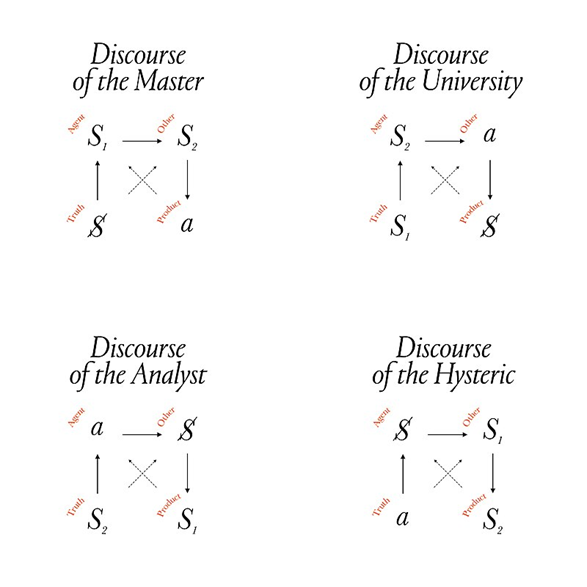
Reading between the lines, that is not what happens. By saying that everything is subjective and therefore there is no objectivity, we have removed the subjectivity from the topic we are discussing; we have objectified it, and this is extremely violent, as we also have established the non-existence of objectivity as an absolute truth. Real violence is not coming from a false belief that we can grasp an objective truth, the real violence resides in that many narratives locate objectivity and subjectivity where it is harmful for individuation, placing the individual in the category of object as a product, just as in slavery. And this can be understood by analyzing speech and the structure of a discourse. Psychoanalyst Jaques Lacan addresses this aspect in careful details, recognizing four discourses which he called Master, University, Hysteric and Analyst, explaining how these relate dynamically to one another.
By neglecting objectivity, we sweep away subjectivity, and the subject -the person-, falls in the place dictated by the Master’s discourse (see image below), where we see a barred subject ($) positioned as master signifier’s truth S1 who itself is positioned as the discourse’s agent for all other signifiers (S2 ). This illustrates the structure of the dialectic of the master and the slave, based on Hegel’s ‘master-slave’ dialectic. The master (S1 ) is the agent that puts the other (S2) to work, and the product is a surplus (object a) that the master struggles to appropriate alone. Please note that the analyst discourse is the only one that places the subject $ in the category of an other.
The message that I am trying to convey here is that crossing out one pole of a dialectic does not make that pole disappear and leave the other pole as the only reference, it does not vanish the dialectic either; rather, the pole that was crossed out now oppresses the other pole from a higher frame.
Likewise, if there is no real boundary condition, the inside-outside dialectic loses meaning, as if by magic there is no outside nor inside, it is a continuum. If we say that there is no real separation anywhere between the outside and the inside, how can that be consistent with the fact that no-thing is defined by itself, but in relation to something else? That some-thing else, which is not outside and is not inside, cannot then be ‘something else’. If there is only a continuum, it contains everything that was, is, and could ever be. No separation between in and out, therefore, that continuum contains itself in a total, absolute way. This totality can be defined with respect to itself; it is not relational. It produces relationships inside, but the thing or substance containing all, is not coming from a relation happening in other frame.
The notion of God could very well fit into this category. The hypothesis that no-thing can be defined by itself since every-thing is defined with respect to something else, thus creating a continuous flow, arrives to a contradiction in the logic unless the existence of God is taken for granted. Under this reasoning, whatever happens inside God, is relational and always partial, while only God is absolute. Only God could know itself, while its creations are inter-dependencies and therefore can never be defined with respect to themselves. They can never be self-contained; they can never know themselves completely and will always remain in ignorance. In consequence, the particular self will never understand the totality, it is beyond our cognition. All these are implications coming from the belief that there is no objectivity and no real boundary condition.
Does this mean that in order to know the totality, one needs the part? Indeed, though then, totality would never reach an absolute state, and we need to understand the relationship of the part with respect to the whole; the nature of the boundary condition, which is why the hologram notion is fundamental in this inquiry. The totality is contained in each of its parts. Information is holographic, and fractal, and this requires the system to remain open. It is not fortuitous that the generalized holographic model GHM unifies forces and scales because it is capable of generalizing the holographic principle to solve the information loss paradox. This unified theory of physics shows how the proton is the holographic unit of the universe; it contains the explicate (the universe) implicated within (each proton). The boundary of a proton is an example of an extremely stable boundary condition. A proton has never been seen to decay (i.e., to disappear or change its size) because it is in holographic relationship with the size of the universe and the information therein.
I am not implying here that all reality is objective or immutable. Nonetheless, if boundaries are mutable, that does not mean that they don’t exist. It only means that they are not fixed, they can change, evolve. I maintain that there must be something real, objective about my existence, since I feel that something exists within me. I don’t know if that which resides in me is the signature of a source that we would all come from, or if that is something of my own, since I don’t know what my-own self is made of. Where does any existence fit in the illusory non-dual perspective? Are we merely a creation of the inter-objectivity of others? What an elegant and subtly violent way to dismiss someone as a subject, by subjecting him exclusively to the subjectivity of others. We have no existence of our own? Am I only the product of the collective hallucination of my environment, and the desire of an Other or of God inhabiting me? Am I merely an object of other’s subjectivity, and everybody else would be as well? Can we feel the violence inside such a claim?
In my view, there is a dance between the objective and the subjective, between the inside and the outside, between the particular and the general, between the absolute and the relative, between the one and the many, one does not superpose permanently on the other, it is a dance between opposites, one containing the other, in which there is a shadow or mirror dialectic that when not considered, forbids the dance between the opposites and stagnates the overall evolution. We need opposites, just as the poles of a battery, to create a tension. The separation frame in opposites may be a matter of cultural or personal choice, it may not be real by itself on its own as it is conditioned by other frames, and we may not agree in the separation frame chosen, but there is a separation frame coexisting with the totality so that BOTH can exist. Is this last claim a fact, or is it an opinion?
This brings us back to our original question, the boundary between opinion and facts … What substance is the boundary condition, or the separation frame, made of? What is its nature?
Before the accomplishment of a unified theory based on the holographic principle, a similar situation was happening with the unification of forces and scales in physics because of the lack of a theory capable of relating the inside to the outside, or charges (i.e., dialectics in opposites positive-negative, matter-antimatter, etc) to mass (a totality, an individualized entity). And we lacked a theory capable of scaling the reference frames of observation.
In the absence of a quantum gravity consensus, we count on artificial neural networks and AI to fill in the gap. The problem is that AI creates an indiscernible continuum neural network since AI is inherently a black box in the sense that the boundary between its hardware and software gets blurred out. Hardware and software mix, they no longer are well-defined separate categories, such that we can no longer discern between the ‘how’ and the ‘what’. How the AI processes information is a black box that not even the AI can discern. Does that mean that there is no ‘hardwareness’ and no ‘softwareness’ in the system? No, it means that the interrelationship between these two categories became explicit. Where does the boundary condition between hardware and software reside? What is it made of?
Science is now trying to define a frame to establish the ‘aliveness’ and ‘consciousness’ boundary. Conditions do not imply interdependence, though unfortunately, we take them as equivalent.
As the generalized holographic solution would say: the thing is not in the thing, but in the relationship between things. What creates the boundary condition of a thing? The relationship between all other things. Does that make the thing less real or less objective? No, it makes everything more malleable and connected, alive, animated, and extremely real. What more ‘realness’ could we expect from anything, beyond its ‘aliveness’ and ‘connectedness’?
Is a ship held in place by an anchor, so as not to drift? Removing the anchor does not cause it to drift, since a drifting ship is solid ground; the only thing that changes is the anchoring frame. Initially the ground was shared between different references, like the harbor outside, and now the ship is its own ground. The boat is now only anchored ‘from within’, subjected to the flowing currents, independent of external fixed frames with respect to it. And yet, seen from the outside, the ship is considered as ‘drifting’. It depends on the observers reference frame, though the frames are entangled as to construct the experience of objectiveness. Therefore, the nature of entanglement, certain aspects forming it as a mechanism, must be independent of the subjects involved. At least some domain remains objective, even if it is extremely nonlinear, and non-local. That is why I prefer to look at a wholeness not only as a living entity, but also as a substance that gathers all these qualities.
Where does within and without reside? What is their nature and relationship? Where does the quality of objectiveness and subjetivesness reside? Where does truth, if any, reside? I don’t know. Perhaps it remains hidden between the lines, in the space between the words and notes, in the space in between … in the rhythm.
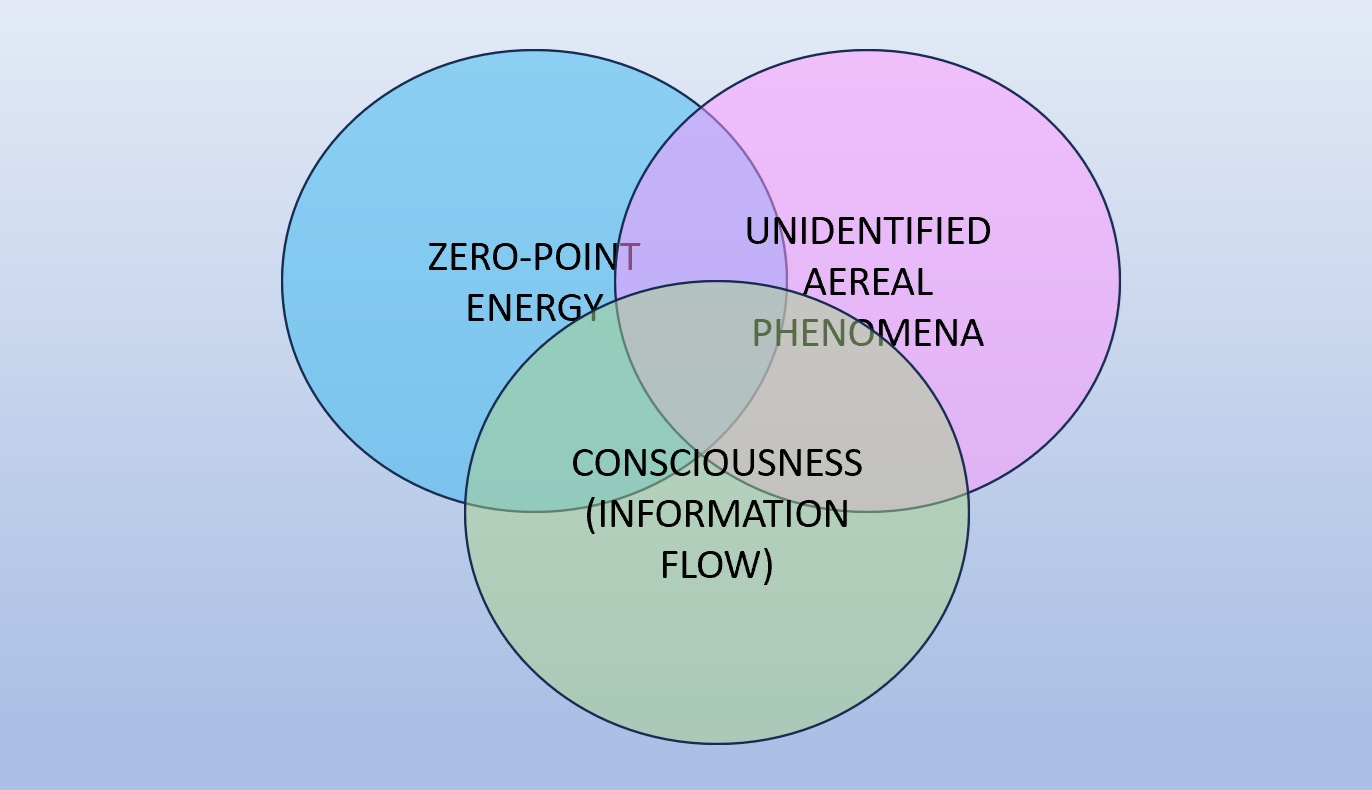
Zero-point energy ZPE (the infinite energy density of space), unidentified aerial phenomena (UAP), and consciousness, are three deeply connected manifestations of the inner nature of reality, and currently they all are being addressed from a scientific perspective. The puzzle seems to be completing, though it is not. Science as a tool for understanding the nature of reality is currently at a crossroad. A fundamental aspect has been missing in our scientific endeavor: the relation between outside reality and inner worlds; the connection between objective and subjective experience, and the connection between the one and the many.
The separation frame between the outside world and the inner experience, as defined by modern science, permeates all its applications; its technology imposes a worldview where the observer is divorced from the observed. This is particularly worrisome, considering that we barely understand our biology or the origin of consciousness, and that at least 96% of the universe’s mass+energy fall under the biggest mystery called dark mass+dark energy, which remain undetected. The biggest pieces of the puzzle are missing in our awareness of the nature of reality …
At the same time, following by inertia the guidelines of a collective movement we don’t fully grasp, we live under the belief that if we need to overcome our limitations, we must become trans-humans, beyond humans, by incorporating technology in our bodies. As if by forcing an external gadget into our bodies it suddenly becomes internal technology that integrates us with the outside world.
Let’s dive in further; an implant allowing a person to walk, or to see again, is a significant achievement, though this does not mean that the person has integrated new information as a part of its body; the implant is still an outsider, which is now inside. Seen from without, the person has recovered, enhanced or expand his abilities, though these are brought by an external factor. If the device dysfunctions, it must be replaced from the outside. Science and technology are truly mind expanding if every single person engages in its development and has an understanding of their own in what its being done, its implications and meaning behind. Otherwise, we can become gadgets ourselves.
Technology can be thought of as a tool to enhance and expand abilities, giving autonomy and increasing well-being. It is supposed to make our lives easier, free from mechanical, automatized labor, liberating our time to be more creative. Though technology goes much deeper than that, it mirrors our level of consciousness and understanding of the nature of reality. Modern science and its technology have made remarkable achievements, though without a link between the internal and the external realms, in awareness that such link may be -and probably is- extremely nonlinear and non-local, humanity is stuck in a world view that empowers hierarchical patriarchal structures, where individuation is determined by power relationships. When power relationships prevail, we follow instructions like automata organic AI’s; we behave as sophisticated machines. No spontaneity, true love and joy can manifest or be experienced in such circumstances, we are mostly a collection of LLM’s, large language models executing a prompt that associates concepts and experiences with no real incarnation, no meaningful action behind. It can become extremely detrimental to our psychological well-being and development.
By developing an individual self-perspective in awareness of its connection to the collective perspective, we empower ourselves to construct our own, honest personal inner technology, such that we are less fearful and more confident in ourselves and the universe we live in, to become responsible co-creators of our reality. The acknowledgement of our inner nature and how it is connected to the outer world increases empathy, emotional well-being and mental health in the individual and therefore, in the collective. Healthy individuation starts understanding our boundary conditions (mental, emotional, physical and spiritual) beyond any theoretical or cultural, collective construct, diving into a grounded, poetical, personal embodiment. One must recognize our own biases and conditioning, to transcend them and grow inwardly.
Following David Bohm’s implicate order terminology, we embody a connection between the enfolded and the unfolded. It is not about gathering information and knowledge; it is about self-realization, i.e., the realization of a self, in an awakened life experience.
The good news is that a science that considers this fundamental aspect, is already here. At Serendipia Science we address consciousness and its relationship to the reality around us using the grounded empirical and theoretical framework of the quantum of consciousness (Q of C), developed by Dr. Inés Urdaneta, physicist in the field of light-matter interaction at the atomic scale.
The quantum of consciousness relates the objective and subjective experience, showing as well how the individual and the collective are related. Such realization has groundbreaking applications ranging from personal development and well-being, up to physics, quantum computing and consciousness technologies.
Learn more about this mind expanding framework, in our course The Science of Serendipity and the Quantum of Consciousness (insert link).
Did you know that the color you perceive from any object, is the opposite to its real color? This fact has deep mind-expanding and unexpected implications. Let’s dive in …
The perception of colors is a complex light-matter interaction that involves mainly three elements: the illuminated object (transmitter), the eye + brain (receiver) and messenger (electromagnetic radiation, i.e., light that bounces off the transmitter and arrives to the receiver). Light-matter interaction is an exquisite and very sophisticated communication process between an outside world and an inner experience, through a physical process known as resonance. Color is resonance happening between matter, or confined vibration (frequencies that carry a certain energy, and that are confined in a region of space) and light (free propagating vibration, i.e., frequencies that also carry or transfer energy). Light-matter interaction is a energy transfer (information transfer) process. In that sense, we can say that reflected light propagates information of matter, and that matter is confined light.
Color is a signature of light-matter interaction that depends on the atomic constitution of matter and its normal modes of vibration – the confined frequencies -, but this feature only reveals itself when light impacts it. The perceived color coming from the object depends on the intensity and energy – frequency, i.e., color- of the incident light, while the message (the reflected or emitted light) is interpreted in one way or another depending on the receiver. A note of caution here, colors are associated to frequencies of light, while perception of color is a different thing. We don’t know if we all see the same red, but we do know that what we mean by red will always be associated to a frequency range of 400 to 480 terahertz (THz), corresponding to a wavelength of approximately 620 to 750 nanometers (nm). Color has an objective aspect, quantifiable as frequency. But the perception of it, is subjective as the biology can change in individuals, for instance in a color blind person. We think we all see the same. One would need a third reference, a witness (internal or external) that could see the tone of red you are seeing and the one that I am seeing, and compare them, to tell up to what point we are perceiving the same tone or color. This is where things get tricky, were is that witness located? Up to what resolution can the differentiation be made?
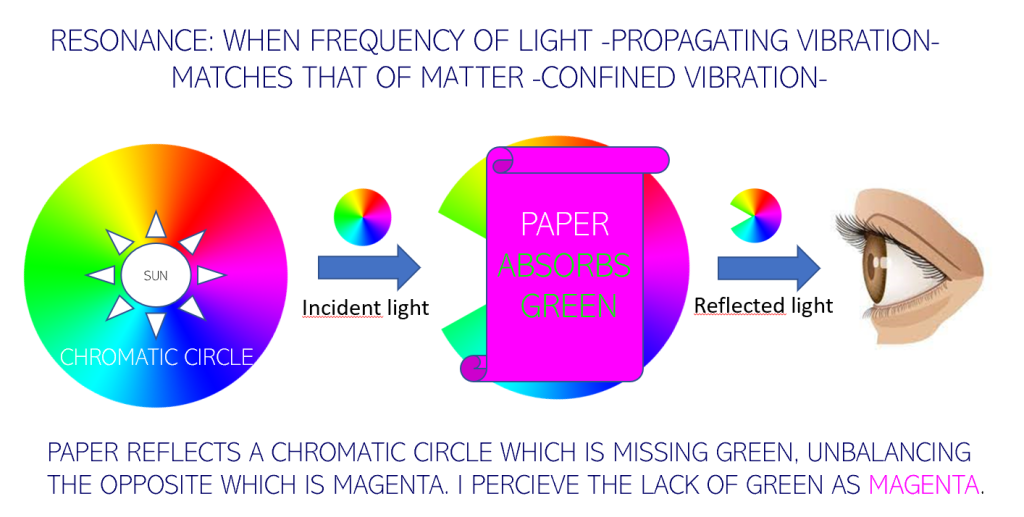
When the light spectrum illuminates an object, the object absorbs certain frequencies from the incident light and their color complement in the incident light spectrum is left ‘unpaired’, alone, traveling back to the receiver as reflected light. This color complement predominates when reaching the eye and perceived by the brain. We see the complementary opposite of what the object’s color is (the frequencies it absorbed). Light bouncing back to the receiver is ‘incomplete’, it lacks some of the frequencies or energies it carried before impacting the object. It is as if the message was given in terms of what the light beam lacks. The case of fluorescence, that is, materials that emit the absorbed light, is more complex and will not be considered here. For a more detailed explanation go to Seeing Color.
The Chromatic circle, known as color wheel.
The chromatic circle known as color wheel, visually depicts colors and their combinations, serving as a fundamental tool in color theory. An interesting thing about it, is that if I make it spin, at a certain rotational frequency, colors are no longer distinguished separately, it looks white to the brain. Wavelengths from the light spectrum arrive on the chromatic circle and each color in the circle absorbs its complementary color from light, reflecting the others. As this happens with all colors equally -all are absorbed and reflected- the reflecting parts reconstitute the original stream of light, and we see it white. Our brain perceives something we call white, which is the sum of the colors reflected by this object that reached the eye. Watch the video below for a more detailed explanation.
An object is seen as magenta because its atomic composition have absorbed on average:
The complementary -green- and the reflected light that bounces off the object does not have green among its components or frequencies. Magenta, which is in opposition to green in the chromatic circle, is de compensated and magenta takes over.
All the colors are absorbed except magenta, and only magenta reaches the eye.
All the colors, minus those who combined in the brain will be seen as magenta.
In all cases the object is (absorbs) all colors or frequencies except the ones that reach the eyes. We perceive light that bounces off objects and that contains the complementary frequencies of the colors absorbed by objects. The light I receive from this object lacks green (case 1, shown in the image below), or all colors except magenta or a combination that recomposes magenta (case 2 and 3), and that is why I see magenta coming form it.
In summary, color is the light that bouncing from objects reaches the eye. That object is ‘being’ magenta from outside, but ‘IS’ green (absorbs green) or is everything but magenta from the inside. It looks magenta, which is what corresponds to the action of seeing it from outside. And it is seen or being perceived to the outside (magenta), as the opposite of what it is, in it self (green). It is a sort of entanglement, where the correlation between magenta and green is that they are in complementary opposition. The object is magenta, means that the object is or absorbs all but magenta. It is like taking its inverse, the negative of it. This is information theory, expressed in terms of light-matter interaction.
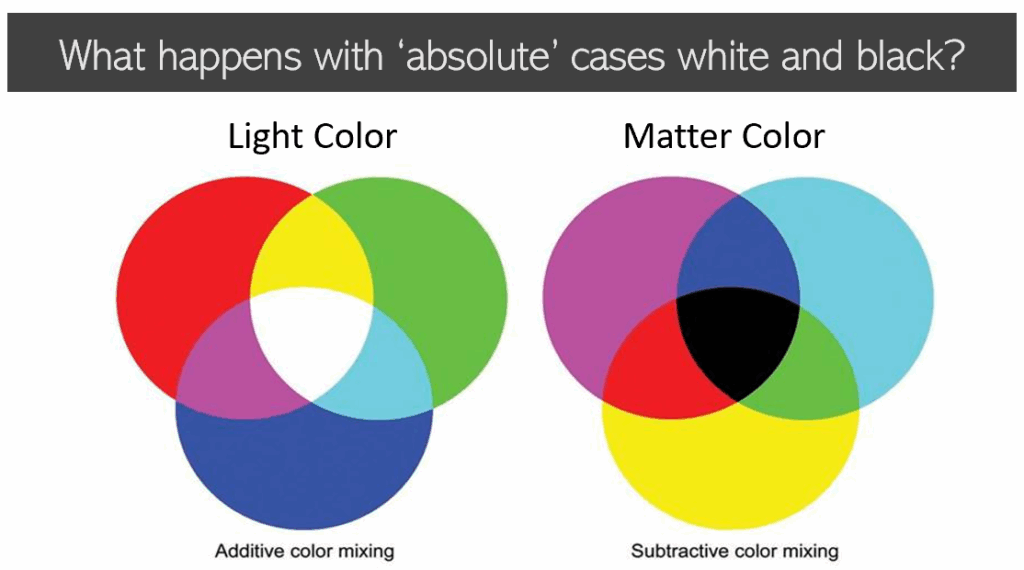
What about extreme cases black and white?
In a white object, the white color does not exist as such, in the sense that I can’t associate it with a set of frequencies. The Sun light (spectrum of ‘all’ wavelengths, including the visible) impacts on a paper constituted of atoms that don’t absorb any of the visible wavelengths, they reflect all and reach the eye. Our convention establishes the presence of all these waves reaching the eye as ‘white’. Meanwhile, a black object is made up of atoms that on average absorb all visible wavelengths; the convention establishes the lack of wavelengths reaching the eye as ‘black’. To be consistent, one should establish a reference; I will call white that which absorbs nothing from the visible spectrum, and black what absorbs all. Black is the absence in the retina (or presence on the object) of all colors been absorbed by this object, while white is their presence in the retina (or absence on the object) of all colors.
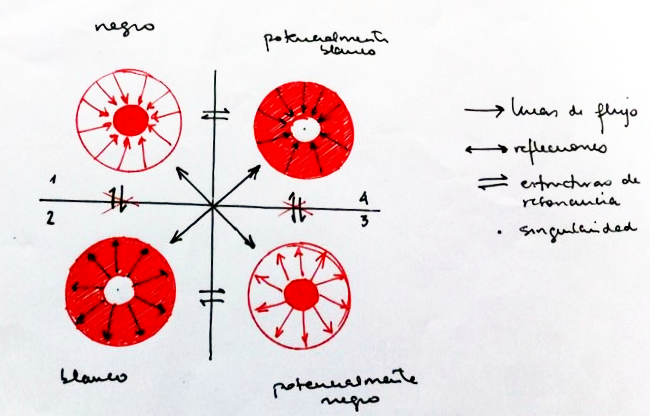
The oil looks black from without, but it is potentially white from within, as it contains all colors of light inside. We could establish an additional reference frame by saying that oil is potentially white from the inside (if the observer is inside the object). Paper looks white from without, though it is potentially black from within, as it lacks all colors of light. It is potentially black from the inside of the paper (if the observer is inside the paper). Potentially black and black differ in their dynamics; the first is going from the inside out (from the object to the observer), while the dynamics of the second is going from the outside in (from the observer to the object). It seems to me that the reference can be set arbitrarily for the first case, and the other cases must be assigned in accordance with the first. The critical factor is the consistency in the reference system, showing the existence of a gradient, a flow, a sense.
How is it with light?
From the rationale we are applying here, it’s not possible to associate light with black or white exclusively. Let’s see why … If white light contains all wavelengths, as if it had absorbed them a priori, I could say that it is fundamentally black from without. If there is an observer capable of seeing light directly and not its effect on objects, the light would then no longer be black, to be potentially black or potentially white according to the new observer.
Considering all these elements, the question, ‘is light white or black? ‘ has a four sided (tetrahedral) answer :
– By Inés Urdaneta, Paris, France (2004).
This result can be reformulated as follows: in order to have a self referring or self-contained frame of observation, one needs at least these four particular reference frames. This seems to be the irreducible representation of information exchange.
Light-matter interaction has deep philosophical implications. The ‘being’ to the outside is characterized by that which depends on the detection system, interaction or measurement, while the being to itself, or simply put ‘self’ is independent of this. The opposites ‘being’ and ‘self’ can only be the same thing if the transmitter and receiver are the same, what is to say that there is no transmission of message. It is the messenger and message at the same time. Light without interacting with any object would fulfill this role, and therefore a observer traveling at the speed of light would also. Though, a famous physicist’s theory explains that no object can travel faster than or at the speed of light in vacuum. Therefore, any-thing traveling at lower speeds cannot be ‘being’, and ‘self’, at the same time. And the origin of the light, that’s another story.
As the observations or measurements of ‘being’ involve the interaction with something that a priori «can only be for itself» (as with light, whose reference is itself), in the search of ‘that what is’ (as with the matter, whose reference is light), we only determine what the object is for who is measuring or observing it, losing the essence of ‘itself’ as long as the description of its «what is it?» (or its ‘being’) increases, since they oppose, no matter the number of states included to define it. This fact is equivalent to Heisenberg’s uncertainty principle in the atomic world: the more accurate is the measurement of the position of a particle, less is the accuracy of the speed of the particle. In simple terms, the more you know about the direction of the particle, the less you know where it is at, and the more you know the position of the particle, the less you know where it is heading to. It also means that the whole is NOT equal to the sum of its parts …
A second deep implication that passes unadvertised, is that if light-matter interaction is a quantum mechanical effect (since matter happens at certain frequencies and the energy exchange between light and matter happens in integer amounts of energy called photons) given that we have addressed this interaction in terms of reference frames, we have linked a critical aspect of quantum mechanics and relativity in a very subtle way: an observation with respect to reference frames (relativity) that when combined becomes self-referring (confined or quantized into a quantum of consciousness), building the notion of ‘an observer’.
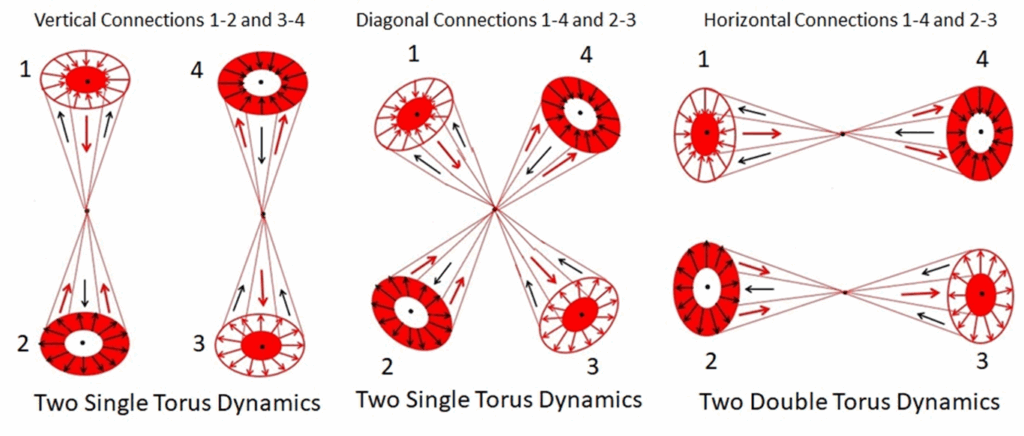
– Connecting the reference frames from the tetrahedral diagram, one obtains currents or flows that are confined in a region of space. These are feedback-feed-forward loops of information flow, that circulate back and forth to a center, building the notion of ‘an observer’, which is also an irreducible representation of information exchange. By Inés Urdaneta, Paris, France (2004).
An observer is a self-referring frame of observation, therefore, it is absolute or universal only with respect to itself. It’s interesting that the flow of information depicts a continuous picture (relativity) which generates a granular picture (quantum mechanics), and vice versa, as if one was embedded in the other, depending on the scale you are looking at. This could also be connected to the wave-particle duality, in a much broader sense than what quantum mechanics tells us. It is not that the particle behaves as a wave or as a particle depending on how you observe it. The particle is made up of waves (oscillations, fluctuations, rotations in a seemingly continuous flow) that are confined (i.e., quantized) in a region of space and those waves are made up of smaller particles (i.e., smaller quanta or confinements of inner flows), such that one will detect a granular or fluid aspect depending on the scale we look at. It is a fractal ‘Russian doll’ type of relationship.
Learn more about this mind expanding framework, in our course The Science of Serendipity and the Quantum of Consciousness (insert link).